

What really happens at weddings when no one's looking? Angela Cappetta's photographs reveal it.
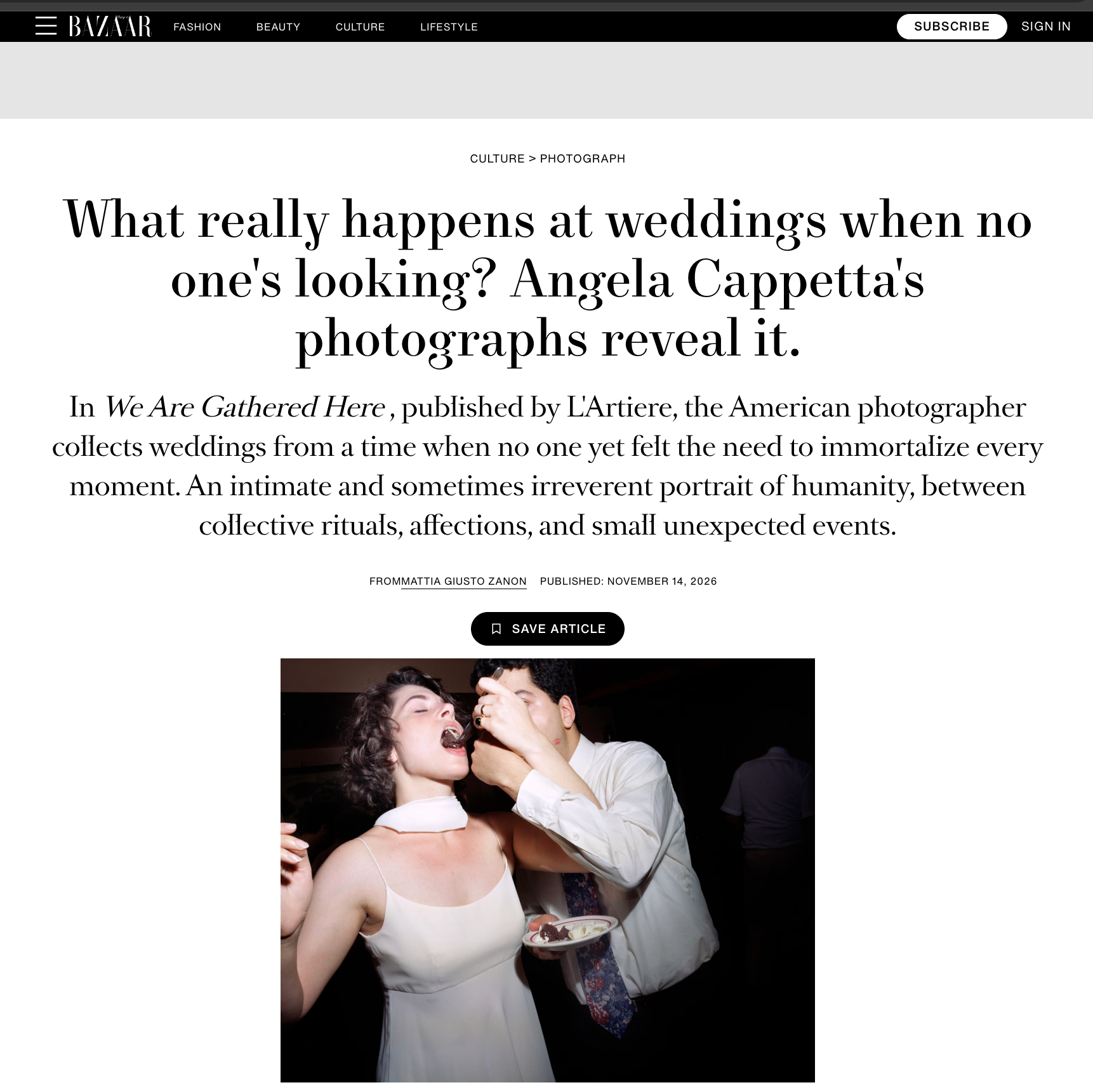
In We Are Gathered Here , published by L'Artiere, the American photographer collects weddings from a time when no one yet felt the need to immortalize every moment. An intimate and sometimes irreverent portrait of humanity, between collective rituals, affections, and small unexpected events.
Published: November 14, 2026
Angela Cappetta / The Artisan
Angela Cappetta has preserved almost everything about weddings, except the actual wedding itself . The vows, the exchange of rings, the kiss between the newlyweds have remained out of frame and out of her gaze. In their place, a far less solemn repertoire of human gestures and weaknesses : abandoned shoes, dozing children overcome by exhaustion, hugs that go on too long, conversations that last until the final toast . For years, these photographs inhabited a private archive, without their author knowing exactly what to do with them. Today, L'Artiere has brought them together in We Are Gathered Here , a volume that tells, through the most conventional of social rituals, how unconventional humanity can be when it forgets to be observed.
The title borrows the words that traditionally open a wedding ceremony: we are gathered here . A formula that, removed from its religious and ceremonial context, takes on a broader, almost anthropological meaning . Because in Cappetta's photographs, marriage is above all an opportunity to study that singular human inclination to gather, celebrate, stage feelings and dynamics. And, inevitably, betray them through a gesture, a glance, a distraction.
Preorder: We Are Gathered Here — ANGELA CAPPETTA
Shot on film with Cappetta's direct and unvarnished approach, these photographs capture a time when people could gather without the constant presence of screens and cameras. The result is both an intimate record of weddings and a wider reflection on community, connection and the ways we come together.
The stolen moments
Brides waiting in front of the mirror, relatives kissing, guests dancing with an abandon that's incompatible with the elegance of their dresses. A woman still wrapped in her veil talks on the phone, a monumental cake demands the attention of a small crowd. Black and white alternates with color, often bright and merciless, while the flash reveals details that an official photograph would likely have excluded. Cappetta doesn't seem interested in portraying the best version of her subjects. She prefers the most authentic version, even when it's awkward, vain, or unintentionally comical.
Angela Cappetta / The Artisan
In her preface, Shana Lopes, curator of photography at the San Francisco Museum of Modern Art (SFMOMA), recognizes this ability to navigate chaos and intimacy as the hallmark of her work. A former wedding photographer's assistant , Lopes knows well the pressure of a day where every moment seems unrepeatable and everyone knows it. Cappetta, on the other hand, allows herself the luxury of ignoring the very thing everyone expects to be immortalized. Her interest lies precisely at the margins of the celebration, where the festive apparatus begins to crack and something less predictable emerges.
Throughout his career, he has photographed the weddings of lawyers, politicians, flamenco dancers , bus drivers, and Oscar winners. A diverse social spectrum, explored with the same curiosity . The locations, clothing, and economic resources vary, but certain behaviors resist any class distinction. The awkwardness of an embrace, the euphoria of a toast, the melancholy that sometimes overtakes guests in the midst of the party, belong to everyone.
Before smartphones
What makes this archive particularly valuable today is also its temporal setting. The images predate the advent of the iPhone , introduced in 2007, and the resulting transformation of our social habits . No one picks up their phone to film the cutting of the cake, no one interrupts a conversation to check a screen. People look, talk, dance, participate. Photography still retains something exceptional: it is an act performed by someone who observes, while others are busy living . Revisiting those celebrations means measuring the distance, now considerable, that separates us from a time when memory did not require continuous documentation.
Sometimes, however, the past erupts with a violence no image could have foreseen . Cappetta recalls photographing, on September 9, 2001, some guests at a wedding in the Hamptons who would die forty-eight hours later in the September 11 attacks. Those photographs, created to celebrate a union, unwittingly became the final portraits of people destined to disappear. It is perhaps the episode that best conveys the ambivalent nature of every family archive: preserving happiness sometimes also means preserving the measure of its fragility.
Glendalis – ANGELA CAPPETTA
Shot exclusively in the pre-gentrified blocks, fields, and buildings of the Lower East Side, the family photographed in this book occupied a multigenerational tenement house on Stanton Street. Their story is told through a protagonist named Glendalis.
After Glendalis: The Life and World of a Youngest Daughter, published in 2024 by L'Artiere, in which Cappetta followed the youngest daughter of a Puerto Rican family from New York 's Lower East Side for about a decade, starting in the 1990s, the photographer returns to interrogate private life through the language of documentary photography. The pages of We Are Gathered Here compose a vast family album, in which everyone could recognize something of their own even without knowing anyone present, and in a certain eternal sense —after all, wedding photographs almost always outlive the weddings themselves.
A Part of Hearst Digital's Harper's BAZAAR participates in various affiliate marketing programs, which means we may get paid commissions on editorially chosen products purchased through our links to retailer sites.
Editor-in-Chief – Massimo Russo
© 2026 HEARST MAGAZINES ITALIA SPA VAT No. 12212110154 - Registered Office: ROC No. 5074 | VIA ROBERTO BRACCO, 6, 20159, MILAN – ITALY